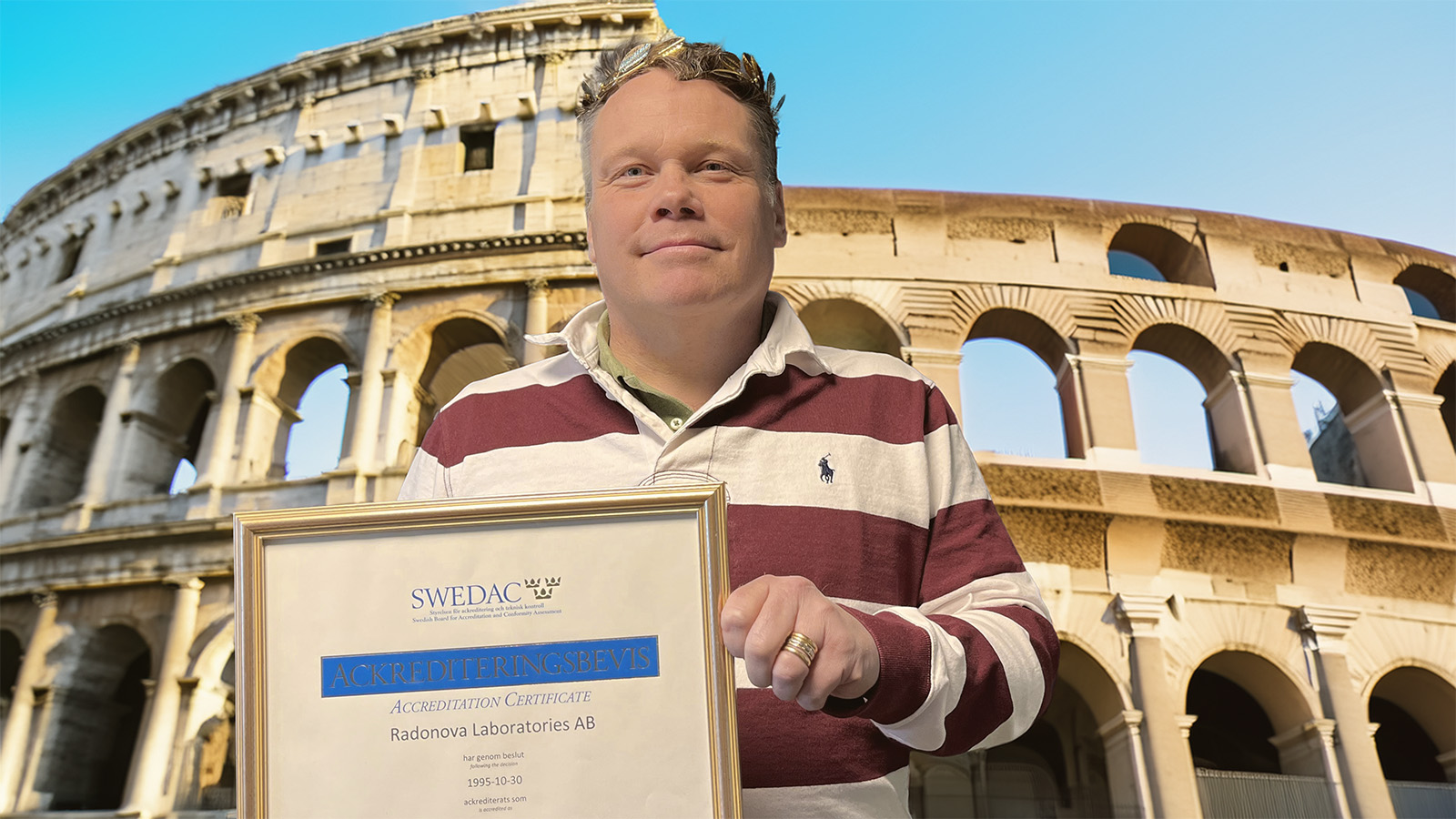
It has now been more than 30 years since Radonova first received accreditation for radon measurements. Since October 1995, the company has provided accredited measurements and analyses based on quality assurance, traceability, and independence. Today, Radonova is one of only a few laboratories worldwide that can demonstrate such a long and uninterrupted history of accreditation in this field.
Radonova history and evolution
- 1986: Founded as Gammadata following the Chernobyl nuclear accident to measure radioactive substances in food and the environment, specifically cesium-137.
- 1995: Formally received accreditation for both radon and cesium measurement methods.
- Present Day: Core focus on accredited radon measurement in air using both track-etch detectors and the electronic radon instrument SPIRIT. Radonova also performs accredited analyses of radon in water and measurements of cesium-137 in materials such as meat, wood products, and ash using gamma spectrometry.
“Both radon measurements using track-etch detectors and cesium measurements have been accredited since 1995. These are methods we have worked with, refined, and quality-assured over a very long period,” says Maria Lindkvist, Quality Manager at Radonova.
What does accreditation mean?
Accreditation is not just a lab status; it is a validated methodology. At its core, it means that a specific measurement or analysis method has been tested and approved in accordance with international standards. For Radonova, this is done under ISO/IEC 17025, the standard for testing and calibration laboratories.
“It is the method itself that is accredited, not the laboratory as such. At the same time, accreditation places requirements on the entire operation – everything from sample handling and calculations to staff competence, documentation, follow-up, and internal audits,” says Maria Lindkvist.
Oversight is carried out by the Swedish national accreditation body, SWEDAC. Audits take place at least every 18 months, meaning that Radonova must continuously demonstrate compliance with all requirements.
Why is accreditation important for customers?
For anyone ordering a radon measurement, accreditation serves as a clear mark of quality. It shows that the measurement results are reliable, traceable, and produced by an independent laboratory. Accreditation provides an added layer of trust for customers that a radon lab provides:
- Technical Competence: Verification of sample handling, calculations, and staff expertise.
- Impartiality: Eliminates conflict of interest in measurement outcomes because the accredited labs have no “vested interest” in the measurement results.
- Risk Mitigation: Prevents underestimation to ensure users aren’t exposed to high radon levels due to faulty data. Prevents overestimation that protects customers from unnecessary and expensive remediation costs.
- Third-party review: An accredited laboratory is regularly assessed by an independent third party, covering methods, procedures, and impartiality.
In a market where many providers offer radon measurements, the difference between accredited and non-accredited services is often decisive.
Continuous monitoring and quality assurance
To maintain its 30-year accreditation record, Radonova employs rigorous quality assurance protocols such as:
- Calibration: Equipment is regularly benchmarked against national radon chambers.
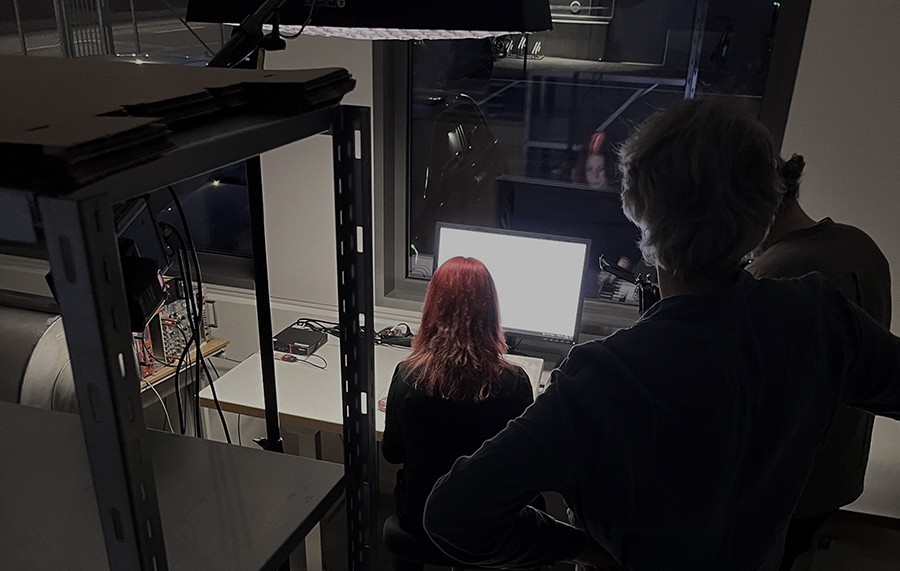
- Intercomparison: Participation in demanding national and international intercomparison exercises to guarantee result accuracy.
- Internal Audits: Continuous documentation and process follow-ups.
Three decades after its accreditation in 1995, the conclusion remains the same: reliable radon measurements require well-defined methods, external oversight, and long-term commitment to quality. This is what underpins every accredited measurement delivered by Radonova.
Radonova was the first radon laboratory in Europe to be accredited for radon measurements.